

Written by: Ryan Gardner, Owner, Managing Partner, CEO, Bucked Up
Key Takeaways
- A healthy amino energy drink typically provides 100 to 200 mg natural caffeine paired with nootropics like L-Theanine for calm, sustained focus without sugar crashes.
- Transparent labeling with disclosed ingredient doses is essential so you can verify effective amounts of caffeine and amino acids instead of guessing through proprietary blends.
- Helpful nootropics to look for include L-Theanine for calm alertness, L-Tyrosine for dopamine support, and Alpha-GPC for mental focus under demanding conditions.
- Powder formats offer dosing flexibility, while ready-to-drink cans provide grab-and-go convenience, so the right choice depends on your daily productivity schedule.
- Bucked Up Energy Drinks provide full label transparency and research-backed nootropics that support focus and alertness.1 Shop the full case lineup here.
How Healthy Amino Energy Drinks Support Focus and Productivity in 2026
The performance beverage market is crowded, and energy drinks are projected to represent 35% of performance beverage revenue in 2026, driven by demand for instant energy and mental alertness among everyday users, not just athletes. That growth means more options and, unfortunately, more noise. A genuinely healthy amino energy drink usually meets four criteria: disclosed ingredient doses, a moderate and natural caffeine source, at least one evidence-supported nootropic amino acid, and a low or zero sugar formulation.
Proprietary blends obscure individual ingredient amounts behind a single combined weight. That structure makes it impossible to know whether you are getting a meaningful dose of L-Theanine or a token sprinkle. Transparent labeling sets the baseline requirement, and every other evaluation step builds from that starting point.
Key Ingredients in Healthy Amino Energy Drinks for Focus and Productivity
Caffeine acts as the anchor ingredient. The NIH Office of Dietary Supplements and the FDA both reference 400 mg as the daily upper limit for healthy adults, which means a single serving in the 100 to 200 mg range leaves room for a second serving or a cup of coffee without approaching that ceiling. Natural sources like green tea extract or coffee fruit often deliver caffeine alongside polyphenols that may smooth the absorption curve.
L-Theanine appears as the pairing that much of the research highlights. A 2025 systematic review and meta-analysis evaluated randomized controlled trials on the effects of L-Theanine plus caffeine on cognition, mood, and sleep in healthy participants, adding to a body of work that has grown steadily in recent years. The mechanism is well-characterized. L-Theanine supports calm alertness* by modulating alpha brain wave activity, which complements caffeine’s adenosine-blocking action instead of competing with it.1
L-Tyrosine serves as a precursor to dopamine and supports mental focus and alertness* under cognitively demanding conditions.1 Alpha-GPC supports the mind-to-muscle connection* and mental focus* through acetylcholine pathways.1 Both ingredients are worth finding on a label with a clearly disclosed milligram amount next to each one.
Choosing Between Powder and Ready-to-Drink Amino Energy Formats
Powder formats give you dosing flexibility, which matters because you can adjust the scoop size to match your caffeine tolerance on any given day. That flexibility also extends to how you mix it, whether with cold or warm water, and powders often deliver a higher ingredient load per serving at a lower cost per dose. The trade-off for these advantages comes through preparation time and portability, since you need water, a shaker, and a moment to mix.
Ready-to-drink (RTD) cans support grab-and-go use, which helps people whose productivity window starts the moment they leave the house. The formulation stays fixed, so what appears on the label is what you get in every can, assuming the manufacturer follows good manufacturing practices. RTDs also tend to use liquid-stable ingredient forms, which can influence which nootropics appear at meaningful doses.
For all-day productivity, the format decision usually comes down to lifestyle. If your focus window sits in a defined morning block, a powder pre-mixed the night before or an RTD grabbed on the way out can both work well. If you often want a second dose mid-afternoon, a powder lets you halve the scoop and reduce the caffeine accordingly. Neither format works better for everyone, so match the format to your schedule and preferences.
Matching Caffeine Tolerance to Your Daily Needs
Regular caffeine use produces tolerance to autonomic effects such as nervousness and jitteriness, so habitual users often experience reduced jitters over time compared with non-habitual users. That tolerance pattern matters when you choose a formula and serving size.
Use the framework in this article as a starting point to identify your likely tolerance range, and treat it as a general guide rather than a prescription for your specific situation. Individual responses to caffeine vary based on genetics, medications, and health conditions, so a healthcare professional can help you decide what fits your circumstances before you change your supplement routine.
At doses typically above 300 to 400 mg, caffeine can cause or worsen anxiety. That risk reinforces the value of keeping daily-use formulas in the moderate range unless tolerance is well established and medically appropriate.
Daily-Use Amino Energy Drinks Without Crash Risk
When you evaluate any amino energy drink for daily use, the checklist stays straightforward: disclosed ingredient doses, natural caffeine source, at least one nootropic amino acid, low or zero sugar, and manufacturing in a GMP-certified facility. That framework helps you compare options side by side.
Bucked Up Energy Drinks can stand out for label transparency. Every ingredient and its dose appears on the label, which lets you cross-reference what you are consuming against the research. The formulas include nootropic ingredients such as Alpha-GPC, which supports mental focus and alertness*, and they are manufactured in GMP-certified facilities in the USA.1 For people who want to know exactly what is in the can, that level of disclosure creates a clear starting point for an informed decision. Find Bucked Up Energy near you or shop the full case lineup below.
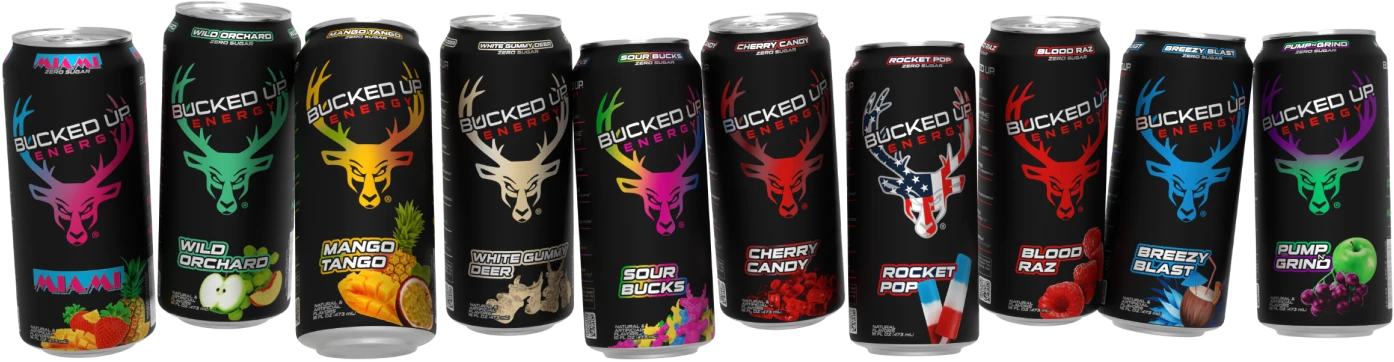
Shop now and stock up on a full case of Bucked Up Energy.
The same criteria apply when you evaluate other options on the market. Look for the caffeine source listed by name, such as caffeine anhydrous, green tea extract, or coffee fruit extract, along with a disclosed milligram amount for each nootropic and a sugar content at or near zero. If a label shows a “focus blend” with a single combined weight, you cannot verify whether any individual ingredient appears at a dose supported by the available research. That pattern creates a label-reading red flag worth considering before you purchase.
Amino acids are the fastest-growing ingredient category in performance beverages in 2026, so more brands are adding amino acid language to their marketing without always delivering meaningful doses. The label remains the most reliable source of truth.
Supporting Brain Fog Relief and Sustained Concentration
Brain fog describes the subjective experience of reduced mental clarity, slower processing, and difficulty sustaining attention. It does not represent a diagnosable condition, and no supplement is approved to treat it. Research does support certain ingredient combinations that help mental focus and alertness* during cognitively demanding periods, which can feel helpful when you experience that foggy state.
A 2025 double-blind, placebo-controlled crossover study found that an L-Theanine and caffeine combination supported reaction time on a neurobehavioural measure of selective attention in acutely sleep-deprived young adults. Sleep deprivation ranks among the most common contributors to the foggy, slow-processing feeling people describe. That research context matters for anyone using an amino energy drink as a morning productivity tool after a short night.
Sustained concentration across a multi-hour work block benefits from avoiding the sharp caffeine spike and subsequent drop that can follow very high single doses. Keeping caffeine in the 100 to 200 mg range and pairing it with L-Theanine supports a smoother alertness curve* rather than a peak-and-crash pattern.
Ingredient Trends in Amino Energy Drinks for 2026
Innovation in the performance beverage space in 2026 is moving toward nootropic and functional layering, with brands incorporating green tea-based caffeine, adaptogens, and electrolytes alongside traditional amino acids. A few specific ingredients are appearing more often on labels.
Alpinia galanga extract (enXtra) has emerged in stacked formulas. A 12-week randomized controlled trial found that enXtra taken alongside caffeine supports a steadier focus curve lasting up to five hours post-ingestion, with no impact on heart rate, blood pressure, or ECG readings.1 That cardiovascular neutrality makes it a practical addition for daily-use formulas that target productivity rather than athletic performance alone.
Huperzine A, already present in Bucked Up’s more advanced pre-workout formulas like BAMF and Mother Bucker, supports memory recall and mental focus* through acetylcholinesterase inhibition.1 Its appearance in energy drink formats follows naturally from the broader nootropic stacking trend. Theobromine, a gentler methylxanthine found in cacao, is also appearing more frequently as a secondary stimulant that supports vitality* without the sharp onset often associated with caffeine anhydrous.1
The broader trend points toward formulas that support cognitive performance across a full workday instead of delivering a single intense energy spike. Clear dosing helps consumers evaluate whether a given formula aligns with that positioning.
Shop now and see the full Bucked Up Energy lineup with disclosed ingredient doses.
Frequently Asked Questions
Is it okay to drink amino energy every day?
For many healthy adults, a daily amino energy drink formulated with moderate caffeine, usually 100 to 200 mg per serving, and well-characterized amino acids like L-Theanine and L-Tyrosine can fit within a balanced diet. Since the daily upper limit is 400 mg (as noted earlier), a single moderate-caffeine serving leaves room for other dietary caffeine sources. L-Theanine is generally recognized as safe within typical serving ranges, though individuals who are pregnant, nursing, or undergoing medical treatment should consult a healthcare professional before daily use.
The key factors for daily use include staying within the recommended caffeine ceiling, choosing a product with a fully disclosed label so you know what you are consuming, and monitoring your own response over time. If you notice disrupted sleep, elevated heart rate, or digestive discomfort, those signals suggest reassessing your intake or speaking with a doctor.
What drinks help with brain fog?
No beverage is approved to treat or cure brain fog, which remains a subjective experience rather than a clinical diagnosis. Certain ingredient combinations found in amino energy drinks are supported by research for their role in supporting mental focus and alertness. Caffeine in the 100 to 200 mg range supports alertness and reaction time, and L-Theanine combined with caffeine has been studied in multiple randomized controlled trials for its role in supporting selective attention and calm focus.
Adequate hydration also plays a foundational role, since even mild dehydration can contribute to reduced cognitive performance. Drinks that combine moderate natural caffeine, L-Theanine, and electrolytes in a zero-sugar format address several practical contributors to that foggy, slow-processing feeling without adding a sugar crash on top. If brain fog is persistent or severe, a healthcare professional, not a supplement label, provides the right next step.
Best energy drink for focus support
The criteria for evaluating an energy drink for focus support stay consistent regardless of who uses it. Look for transparent ingredient labeling with disclosed doses, a moderate natural caffeine source, at least one nootropic amino acid such as L-Theanine, L-Tyrosine, or Alpha-GPC, and a low or zero sugar formulation to avoid glucose-related energy fluctuations.
For individuals who feel sensitive to stimulants or who experience heightened anxiety with caffeine, a lower-caffeine formula, often 50 to 100 mg, paired with a higher L-Theanine dose can provide a practical starting point. Consulting a healthcare professional before adding any new supplement to a daily routine is always the appropriate first step, particularly for individuals managing any health condition or taking prescription medications. The goal is to find a formula that supports sustained mental focus and alertness throughout the day without causing jitteriness or disrupting sleep, and that process starts with careful label reading.
Conclusion
The evaluation framework for healthy amino energy drinks for focus and productivity in 2026 centers on four verifiable criteria. Look for a disclosed caffeine dose in the 100 to 200 mg range from a natural source, at least one nootropic amino acid with a listed milligram amount, low or zero sugar, and a transparent label that avoids proprietary blends that hide individual doses. The research on caffeine and L-Theanine combinations continues to expand, as discussed earlier, and the market is moving toward more sophisticated nootropic stacking. That evolution creates more options and more reasons to read labels carefully instead of relying on marketing language alone.
Bucked Up Energy can stand out in this category for consumers who prioritize label transparency and want to cross-reference what they are consuming against available research. Every ingredient and dose appears on the label, the formulas are manufactured in GMP-certified facilities in the USA, and the nootropic stack supports mental focus and alertness* in a format designed for everyday achievers, not just athletes.
Shop now and stock your case of Bucked Up Energy.
*These statements have not been evaluated by the Food and Drug Administration. This product is not intended to diagnose, treat, cure, or prevent any disease.
1 The content provided in this article is for informational purposes only and is not medical advice. Consult with a medical professional before implementing any changes to your diet, health, or exercise routines.
Individual results will vary and are based on a combination of each individual’s diet, exercise, age, and health circumstances.
These statements have not been evaluated by the Food and Drug Administration. This product is not intended to diagnose, treat, cure or prevent any disease.
This article was written by Ryan Gardner, CEO of Bucked Up. As the maker of Bucked Up Energy Drinks, we have a financial interest in this information. The views expressed are our own and should be read with that context in mind.


Leave a Reply