

Written by: Ryan Gardner, Owner, Managing Partner, CEO, Bucked Up
Key Takeaways
-
The ideal energy drink for studying pairs 100–200 mg caffeine with 100–200 mg L-theanine plus added nootropics in a zero-sugar, fully disclosed formula.
-
Research shows the caffeine-L-theanine combination improves attention, task switching, and perceived stress compared with caffeine alone.
-
Zero-sugar formulas help prevent blood-sugar crashes that can derail focus during long study sessions.
-
Transparent labeling with exact milligram amounts for every ingredient lets you verify effective doses and avoid hidden proprietary blends.
-
Ready to power through your next study session, order a Bucked Up energy drink case for delivery and keep your fridge stocked.
What Makes an Energy Drink Good for Studying Focus Without Jitters
Sustained mental performance over a 4-plus-hour study session requires more than a quick caffeine spike. Four factors separate a genuinely useful drink from a marketing exercise: ingredient selection, dose transparency, sugar content, and third-party manufacturing standards.
Caffeine at moderate doses supports mental focus and alertness.1* Mayo Clinic notes that millions of people use caffeine daily to stay alert and concentrate better, while also flagging that heavy use can cause nervousness, fast heartbeat, and muscle tremors. The safe daily ceiling sits at 400 mg for most adults. Staying within the 100–200 mg range per serving keeps the benefits while reducing the overstimulation that can derail focus.
L-theanine changes the equation when paired with caffeine. Controlled human trials including Owen et al. (2008), Haskell et al. (2008), Giesbrecht et al. (2010), and a Kelly et al. (2016) meta-analysis found that caffeine plus L-theanine improves cognitive performance and mood more than either ingredient alone. The combination supports improved attention, better task switching, and reduced perceived stress compared with caffeine alone.1
Zero sugar matters for a different reason. Blood sugar spikes from high-sugar drinks can create the exact crash pattern that makes studying unreliable. A zero-sugar formula removes that variable entirely and keeps the focus on the nootropic ingredients.
Key Focus Ingredients to Look For in an Energy Drink
Effective focus ingredients need to appear at studied doses, not just on the label.
Caffeine (100–200 mg per serving). Supports mental focus and alertness.1* A single 200 mg serving leaves room for a second drink or a cup of coffee without approaching the 400 mg daily threshold mentioned earlier.
L-Theanine (100–200 mg per serving). An amino acid from green tea that increases alpha brainwave activity to promote wakeful relaxation and calm focus without sedation.1 A 2025 meta-analysis identified 200 mg as the most consistent effective dose for attention-heavy tasks. The combination with caffeine at roughly a 2:1 L-theanine-to-caffeine ratio is the most studied pairing for focus without jitteriness.
Alpha GPC. A choline-containing compound that supports mental focus and the mind-to-muscle connection.1* Bucked Up uses AlphaSize® Alpha GPC in its formulas, a form with documented use in focus-support research.
Huperzine A. A nootropic that supports memory recall and focus.1* It appears in Bucked Up’s Mother Bucker and BAMF pre-workout formulas.
L-Tyrosine. An amino acid precursor to dopamine that supports cognitive performance during demanding tasks.1* Mother Bucker includes L-Tyrosine at a disclosed dose.
B Vitamins (especially B12 as Methylcobalamin). Support neurological function and energy metabolism.1* These appear in the standard Bucked Up formula.
How to Evaluate Energy Drink Labels for Study Sessions
Start with the label when you evaluate an energy drink for studying. A fully disclosed label lists every ingredient with its exact milligram amount. Proprietary blends, which group multiple ingredients under a single total weight, make it impossible to verify whether any individual ingredient is present at a dose that actually supports the claimed function.
Once you confirm full ingredient disclosure, check sugar content next. Zero-sugar formulas remove the blood sugar variable that can work against the focus benefits you just verified on the label. With transparency and sugar content confirmed, verify caffeine per serving against the 100–200 mg target range for moderate, sustained support.
Third-party manufacturing standards provide a quality baseline. GMP-certified manufacturing means the product was made under consistent quality controls. Bucked Up products are manufactured in the USA in GMP-certified facilities.
Finally, look for additional nootropic ingredients at disclosed doses. A label that lists a “nootropic blend” without individual amounts gives no insight into whether those ingredients appear at levels that have been studied.
What Energy Drink Profile Helps Reduce Jitters
Jitters from energy drinks mainly come from high caffeine doses and a lack of counterbalancing ingredients. Pairing 100–200 mg L-theanine with 50–150 mg caffeine at a 2:1 L-theanine-to-caffeine ratio smooths jitters while preserving focus.1 Drinks that deliver 300 mg or more of caffeine without any L-theanine can feel overstimulating for caffeine-sensitive individuals.
The L-theanine and caffeine combination produces smoother alertness and fewer overstimulation effects than caffeine alone1, consistent with reduced jitteriness during demanding cognitive tasks. This smoother alertness profile, documented in the studies above, translates directly to a calmer focus experience during study sessions.
Which Energy Drink Setup Supports Brain Focus
The research points to a specific ingredient stack rather than a single product. A placebo-controlled study reported that the combination of 50 mg caffeine and 100 mg L-theanine enhanced accuracy and mental processing speed during attention-switching tasks and improved the ability to block out distractions during memory testing (Owen et al., 2008). A separate study found that 250 mg L-theanine and 150 mg caffeine reduced subjective ratings of “headache” and “tired” while increasing “alert” compared with caffeine alone (Haskell et al., 2008).
For brain focus, the drink that performs well delivers verified doses of caffeine and L-theanine together, adds disclosed nootropic support, and avoids sugar. That remains an ingredient-profile question, not a brand question. Evaluate the label against those criteria.
What Drinks and Ingredients Support Mental Clarity
Mental clarity during extended cognitive work benefits from ingredients that address both stimulation and stress modulation. Beyond the core caffeine-L-theanine pairing that drives focus, citicoline supports focus, attention, memory, and mood in healthy individuals. Bacopa monnieri extract standardized to 24% bacosides has been shown to support memory performance and slow the rate of forgetting newly acquired knowledge during prolonged cognitive tasks.
Hydration also plays a role in mental clarity. Even mild dehydration affects concentration. A drink that includes electrolytes, such as sodium and trace minerals, supports fluid balance during long sessions. Bucked Up formulas include Himalayan Rock Salt with trace minerals for this reason.
The global functional beverage market is valued at approximately $157.9 billion in 2025, with nootropic-focused drinks representing one of the faster-growing segments. Consumer demand for transparent, focus-first formulas is driving that growth, which creates more options but also more noise to sort through.
Practical 4-Hour Study Session Protocol
Timing and stacking matter as much as ingredient selection. Use this framework for a 4-hour study session built around a 100–200 mg caffeine plus L-theanine energy drink.
T-minus 15 minutes before the session starts. Drink 8–12 oz of water first. Starting hydrated removes one variable from any focus issues that arise mid-session. Then open your energy drink.
First 90 minutes. This window usually brings peak alertness for most people using a moderate caffeine dose. Use this time for the highest-demand cognitive work: reading dense material, problem sets, and writing that requires original thinking.
90-minute mark. Take a 5–10 minute break. Stand up, move, and drink more water. Caffeine can disrupt sleep if consumed too late in the day. If this session runs into the evening, factor in the 6–8 hour window before your target sleep time when deciding whether to have a second drink.
Hours 2–4. The L-theanine component supports sustained attention across the full task window. A double-blind, placebo-controlled EEG study found that 250 mg L-theanine supported sustained attention and overall task engagement across the full timeframe of a demanding cognitive task (Gomez-Ramirez et al., 2009). Because the L-theanine effect maintains engagement even as caffeine’s peak wears off, this window fits lighter review work, flashcards, and practice problems that benefit from steady attention rather than peak intensity.
Hydration throughout. Aim for at least 16 oz of water per hour of study time alongside your energy drink.
Bucked Up energy drinks are available online and at retail locations. Find a store near you using the Bucked Up store locator. Ready to stock up for the semester, order a full case for delivery and keep study fuel on hand.
Bucked Up Focus-Oriented Formulas
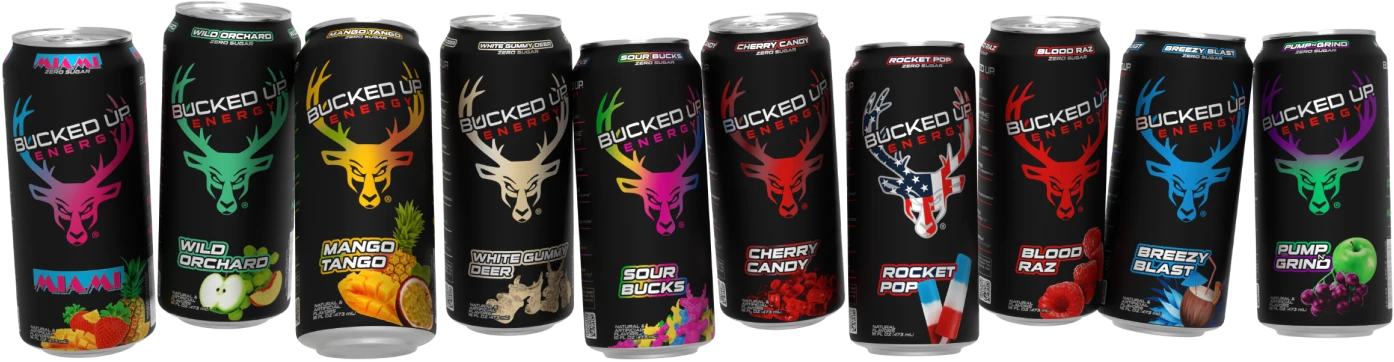
Bucked Up energy drinks use fully disclosed ingredient amounts, zero sugar, and a focus-first ingredient profile. That means every amount on the label is the actual amount in the can, with no proprietary blends, no hidden doses, and no guessing whether an ingredient appears at a studied level.
The standard Bucked Up formula delivers 300 mg caffeine per serving, which sits at the upper end of the moderate range supported by the research above. It includes AlphaSize® Alpha GPC 50%, which supports mental focus and alertness,1* along with Taurine, which may support cognitive functions,* Vitamin B12 as Methylcobalamin for neurological function support,* and Himalayan Rock Salt with trace minerals for electrolyte balance support.*
For those who want a fuller nootropic stack, the BAMF pre-workout formula adds Dynamine, AlphaSize®, and Huperzine A specifically for focus support.1* Mother Bucker includes L-Tyrosine, Alpha GPC, and Huperzine A at disclosed doses alongside 300 mg caffeine anhydrous plus 100 mg microencapsulated delayed-release caffeine.1 That profile suits advanced users with higher stimulant tolerance rather than the 100–200 mg study-session range.
For caffeine-sensitive individuals or evening study sessions, the Non-Stimulant Pre-Workout delivers AlphaSize® and other focus-supporting ingredients without any caffeine. This approach removes the sleep disruption variable entirely.
The through-line across every Bucked Up formula is simple: the label shows exactly what is in it. That transparency forms a baseline requirement for evaluating any energy drink against the criteria in this article, and it is the standard Bucked Up holds itself to.
Browse the full Bucked Up energy drink lineup to find the formula that fits your study session protocol.
Conclusion: Choosing an Energy Drink for Studying
The healthiest energy drink profile for studying focus without jitters follows a specific, verifiable pattern. A range of 100–200 mg caffeine, 100–200 mg L-theanine, additional nootropic support at disclosed doses, zero sugar, and a fully transparent label aligns with current research. That profile draws on peer-reviewed work on the caffeine-L-theanine combination and expert guidance on safe caffeine intake. Evaluate any drink against those criteria before buying. Bucked Up energy drinks are formulated to align with that standard and provide full ingredient disclosure on every can. Explore Bucked Up formulas to find the right one for your next study session.
*These statements have not been evaluated by the Food and Drug Administration. This product is not intended to diagnose, treat, cure, or prevent any disease.
Frequently Asked Questions
How much caffeine should an energy drink have for studying without causing jitters?
Most people find that 100–200 mg of caffeine per serving supports mental focus and alertness without the overstimulation associated with higher doses. This range allows for sustained cognitive performance across a multi-hour study session while staying well within the 400 mg daily ceiling that nutrition experts consider safe for most healthy adults. Pairing caffeine in this range with 100–200 mg of L-theanine further smooths the stimulant effect, supporting cleaner focus with less risk of jitteriness or restlessness. Individuals who are sensitive to caffeine may want to start at the lower end of that range and assess their response before increasing.
What is L-theanine and why does it matter in an energy drink for studying?
L-theanine is an amino acid found naturally in green tea. It supports the same alpha brainwave activity and calm focus described earlier, which is why it pairs so effectively with caffeine to smooth out jitters. When combined with caffeine, L-theanine supports mental focus and alertness while reducing the jittery, overstimulated feeling that caffeine alone can produce in some people. Multiple peer-reviewed studies have examined the caffeine-L-theanine combination and found it supports improved attention, better task switching, and reduced perceived stress compared with caffeine alone. For studying, this pairing can support sustained engagement across a long session rather than a sharp spike followed by a drop in concentration.
Are zero-sugar energy drinks actually better for focus than regular energy drinks?
Zero-sugar formulas remove a variable that can work against sustained focus. High-sugar drinks can contribute to blood sugar fluctuations that affect energy levels and concentration over time. A zero-sugar energy drink with a well-formulated nootropic stack delivers the cognitive support ingredients without that variable. For a 4-plus-hour study session where consistent mental performance matters, removing unnecessary sugar provides a straightforward way to reduce the risk of mid-session energy disruption. Zero-sugar does not automatically mean a drink is effective for focus, so the ingredient profile still needs to meet the criteria outlined above.
How do I know if an energy drink has transparent labeling?
A transparently labeled energy drink lists every ingredient with its individual milligram amount on the supplement facts panel. If you see a “proprietary blend” or “focus matrix” that groups multiple ingredients under a single combined weight, you cannot verify whether any individual ingredient is present at a dose that has been studied for cognitive support. Transparent labeling means you can look up each ingredient and its listed dose independently and evaluate whether the amounts align with the research. Bucked Up discloses every ingredient amount on its labels, which is the standard to look for when evaluating any energy drink for studying.
Can I use a Bucked Up energy drink for studying even if I am sensitive to caffeine?
Caffeine sensitivity varies significantly between individuals. For those who experience jitteriness, restlessness, or sleep disruption at moderate caffeine doses, Bucked Up offers a Non-Stimulant Pre-Workout that contains no caffeine while still delivering focus-supporting ingredients including AlphaSize® Alpha GPC. For evening study sessions where caffeine timing is a concern, a stimulant-free option removes the sleep disruption risk entirely. If you are new to caffeinated supplements, starting with a lower-caffeine formula and assessing your individual response before moving to a higher dose is a reasonable approach. Anyone with underlying health conditions should consult a healthcare provider before adding caffeinated supplements to their routine.
References
Giesbrecht, T., Rycroft, J. A., Rowson, M. J., & De Bruin, E. A. (2010). The combination of L-theanine and caffeine improves cognitive performance and increases subjective alertness. Nutritional Neuroscience, 13(6), 283–290.
Haskell, C. F., Kennedy, D. O., Milne, R. D., Wesnes, K. A., & Scholey, A. B. (2008). The effects of L-theanine, caffeine and their combination on cognition and mood. Biological Psychology, 77(2), 113–122.
Kelly, S. P., Rycroft, J. A., Owen, G. N., & De Bruin, E. A. (2016). L-theanine and caffeine in combination: A systematic review and meta-analysis of the psychophysiological effects. Nutrition Reviews, 74(10), 668–675.
Mayo Clinic. (2025). Caffeine: How much is too much? https://www.mayoclinic.org/healthy-lifestyle/nutrition-and-healthy-eating/in-depth/caffeine/art-20045678
Owen, G. N., Parnell, H., De Bruin, E. A., & Butler, L. F. (2008). The combined effects of L-theanine and caffeine on cognitive performance and mood. Psychopharmacology, 199(3), 421–436.
1 The content provided in this article is for informational purposes only and is not medical advice. Consult with a medical professional before implementing any changes to your diet, health, or exercise routines. Individual results will vary and are based on a combination of each individual’s diet, exercise, age, and health circumstances. These statements have not been evaluated by the Food and Drug Administration. This product is not intended to diagnose, treat, cure or prevent any disease.
This article was written by Ryan Gardner, CEO of Bucked Up. As the maker of Bucked Up Energy Drinks, we have a financial interest in this information. The views expressed are our own and should be read with that context in mind.


Leave a Reply