

Written by: Ryan Gardner, Owner, Managing Partner, CEO, Bucked Up
Key Takeaways
-
L-theanine paired with caffeine supports relaxed wakefulness and steady focus without overstimulation when used at researched ratios.1
-
Exact milligram amounts of both L-theanine and caffeine must be listed on the label to verify an effective ratio.
-
Total caffeine content should match individual tolerance, which is why multiple caffeine levels are offered across Bucked Up Performance Energy Drinks.
-
Sugar-free formulas avoid energy spikes and crashes, so focus support comes from functional ingredients instead of a sugar rush.
-
Bucked Up Performance Energy Drinks meet all five focus criteria with full transparency; see the labels yourself.
How L-Theanine and Caffeine Work Together for Calm Focus
L-theanine is an amino acid found naturally in tea leaves. Its chemical structure is similar to the neurotransmitter glutamate, which allows it to interact with glutamate-related receptors without activating them as strongly as glutamate itself. This interaction dampens excessive neuronal stimulation without causing drowsiness. L-theanine also promotes alpha-wave brain activity and supports inhibitory neurotransmitters including GABA and serotonin, stabilizing neural activity even as caffeine increases arousal.
Caffeine works through a different pathway entirely. It blocks adenosine receptors to raise dopamine and norepinephrine levels. L-theanine does not act on adenosine. Instead, it raises GABA to improve signal clarity, increases striatal dopamine release, and tempers glutamate-driven excitation. This combination allows caffeine’s alertness support to produce clearer selective attention rather than unfocused stimulation.1
This complementary mechanism produces measurable performance effects. In a 2025 controlled study of healthy young adults after 20 hours of sleep deprivation, the combination of 200 mg L-theanine and 160 mg caffeine produced a 38 ms reaction-time advantage over placebo and improved signal-detection accuracy. Those effects did not appear with either compound alone. Beyond objective performance metrics, the combination also affects subjective experience. A separate placebo-controlled study found that 250 mg L-theanine plus 150 mg caffeine reduced subjective ratings of headache and tiredness while supporting alertness compared to caffeine alone.
These are structure/function observations, not disease treatment claims. L-theanine and caffeine together support mental focus and alertness.* They do not treat or cure any condition.1
Ratio Transparency: Seeing L-Theanine and Caffeine Numbers Clearly
The most important detail on any energy drink label claiming L-theanine benefits is whether the milligram amounts for both caffeine and L-theanine are listed separately and explicitly. Under 21 CFR §101.4, ingredients must be declared by their common or usual name in descending order of predominance by weight. That rule does not require brands to publish exact milligram amounts for every ingredient. Some formulations use proprietary blends that list ingredients without individual dosages, which makes it impossible to evaluate whether the ratio is meaningful.
A commonly recommended ratio for the L-theanine and caffeine combination is 2:1 (theanine to caffeine). Research frequently tests 100 to 200 mg L-theanine paired with 50 to 150 mg caffeine. You can only tell whether a product hits that range when you see the numbers. Bucked Up Performance Energy Drinks publish exact milligram amounts on every can, so the math is never a guessing game. Find them at a retailer near you and read the label before you buy.
Total Caffeine: Matching the Drink to Your Day
Total caffeine content should fit the situation and your tolerance. A morning deep-work block before a full training session calls for a different caffeine load than an afternoon meeting after a short night of sleep. Many consumers now look for products that support a balanced, stable, and capable feeling throughout the day rather than peak stimulation. That shift makes caffeine flexibility an important factor when you evaluate energy drinks with L-theanine for focus.
Bucked Up Performance Energy Drinks offer multiple caffeine options designed for different tolerance levels and use cases. Someone who is caffeine-sensitive can choose a lower-caffeine option, while a person with a well-established tolerance can reach for a higher-caffeine formula. That range matters because the L-theanine-to-caffeine ratio only works as intended when the caffeine dose fits the individual consuming it.
Sugar Profile: Keeping Energy Clean and Steady
Beyond caffeine and L-theanine dosing, the base formula matters. Sugar creates its own energy arc, and that arc tends to end in a dip. For anyone trying to maintain sustained mental focus across a long work session or training block, a sugar spike layered on top of a caffeine spike works against that goal. Focus beverages increasingly incorporate gentler sources of caffeine along with B vitamins to support energy without jitters or the crash, and zero-sugar formulations appear often in that shift.
Bucked Up Performance Energy Drinks are sugar-free. The energy and focus support* come from the functional ingredient stack, not from a sugar curve running underneath it. For Everyday Achievers who want clean, consistent output across a full day, that distinction has real impact.
Taste and Flavor: Making Daily Use Feel Easy
A clean formula only helps if you actually drink it consistently. A product that works but tastes like a chemistry experiment will not get opened every day. As Danny Stepper, CEO of LA Libations, put it: “The consumer is not going to sacrifice taste just to get functionality. They want it all.” That preference shapes buying decisions. Consistent use determines whether a functional ingredient stack delivers results over time, and consistency depends heavily on whether someone actually wants to drink the product.
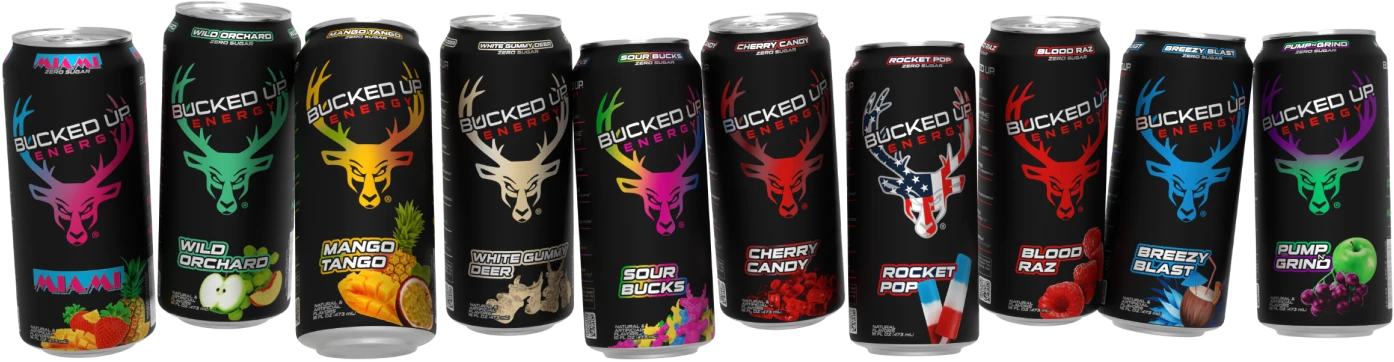
Bucked Up’s flavor innovation is a core part of the brand’s identity, not an afterthought. Crave-worthy taste is built into the formulation process from the start, which is why the product line continues to expand with new flavor options. Find a flavor worth reaching for every day.
Extra Ingredients That Support Focus
Caffeine and L-theanine form the foundation, but a well-constructed energy drink for focus can layer in complementary ingredients that support mental performance through additional pathways. Growing interest in benefit stacking is clear, with many people expecting one beverage to address multiple needs at once, such as energy plus calm or focus plus wellness. When you evaluate a label, look for ingredients with established roles in supporting cognitive function.*
Bucked Up Performance Energy Drinks include ingredients beyond caffeine and L-theanine that are selected to support mental focus and alertness.*1 The full ingredient list appears on every can and on the product page, consistent with Bucked Up’s commitment to full label transparency. No proprietary blends. No hidden amounts. What you see is what you get.
Answering Your Top Questions About L-Theanine and Energy Drinks
What is the ideal caffeine-to-L-theanine ratio for focus?
Research most frequently examines a 2:1 ratio of L-theanine to caffeine, meaning twice as much L-theanine as caffeine by milligrams. Studies have tested combinations such as 200 mg L-theanine with 100 mg caffeine, 200 mg L-theanine with 160 mg caffeine, and 97 mg L-theanine with 40 mg caffeine, with attention and alertness support observed across these ranges. A 1:1 ratio also appears in formulations and may be appropriate depending on individual caffeine tolerance. The most important step is finding a product that publishes both numbers so you can evaluate the ratio yourself rather than guessing from a proprietary blend.
Does L-theanine actually reduce jitteriness from caffeine?
Multiple controlled human trials have examined this question, including the study mentioned earlier showing reduced headache and tiredness ratings with the 250 mg/150 mg combination. As discussed earlier, L-theanine’s modulation of inhibitory neurotransmitters allows it to temper caffeine’s excitatory effects without blocking alertness.1 These are structure/function observations about how the combination supports normal brain activity,* not a guarantee of any specific outcome for any individual.
Can I drink an L-theanine energy drink in the afternoon without disrupting sleep?
This depends primarily on the total caffeine content and your individual caffeine metabolism, not on the L-theanine. L-theanine does not sedate or counteract caffeine’s stimulatory effects entirely. It modulates them. Caffeine has a half-life of approximately five to six hours in most adults. That means a 150 mg dose consumed at 3 PM may still have a meaningful effect at 8 PM. If afternoon use is a priority, look for energy drinks that offer lower caffeine options and check the total milligrams on the label. Bucked Up Performance Energy Drinks offer multiple caffeine levels specifically to address different timing and tolerance needs.
Does it matter whether the caffeine in an energy drink is natural or synthetic?
Chemically, caffeine anhydrous (the synthetic form) and naturally derived caffeine from sources like green tea or guarana are structurally identical molecules. The body processes them through the same pathways. For sustained focus, total dose, delivery format (standard versus delayed-release), and the presence of L-theanine or other complementary ingredients matter more than source. Some consumers prefer natural caffeine sources for personal or dietary reasons, which is a valid preference, but it does not change the underlying pharmacology of how caffeine interacts with L-theanine in the body.
Conclusion: Use These Criteria to Compare Labels
Five criteria are worth applying to any energy drink claiming L-theanine focus benefits. Look for ratio transparency, with exact milligrams of both caffeine and L-theanine published on the label. Check that total caffeine content matches your tolerance. Prefer a sugar-free or low-sugar formula. Choose a taste profile you will actually reach for consistently. Finally, look for a complementary ingredient stack that supports mental focus through additional pathways.* Bucked Up Performance Energy Drinks are formulated to meet each of these criteria, with full label transparency as a non-negotiable starting point.1
Use this framework on every label you pick up. If the milligrams are not listed, the ratio cannot be evaluated. If the ratio cannot be evaluated, the focus claim cannot be verified. Start with the label. Compare Bucked Up labels online or find them at a retailer near you.
*These statements have not been evaluated by the Food and Drug Administration. This product is not intended to diagnose, treat, cure, or prevent any disease.
References
BevSource. (2026). Beverage trends 2026. https://bevsource.com/news/beverage-trends-2026
Beverage Daily. (2026, April 24). Functional beverage trends: Gut health, fibre, energy, hydration. https://beveragedaily.com/Article/2026/04/24/functional-beverage-trends-gut-health-fibre-energy-hydration
U.S. Food and Drug Administration. (2005). Dietary supplement labeling guide. https://fda.gov/food/dietary-supplements/dietary-supplement-labeling-guide
Electronic Code of Federal Regulations. (n.d.). 21 CFR Part 101: Food labeling. https://ecfr.gov/current/title-21/chapter-I/subchapter-B/part-101
1 The content provided in this article is for informational purposes only and is not medical advice. Consult with a medical professional before implementing any changes to your diet, health, or exercise routines. Individual results will vary and are based on a combination of each individual’s diet, exercise, age, and health circumstances. These statements have not been evaluated by the Food and Drug Administration. This product is not intended to diagnose, treat, cure or prevent any disease.
This article was written by Ryan Gardner, CEO of Bucked Up. As the maker of Bucked Up Energy Drinks, we have a financial interest in this information. The views expressed are our own and should be read with that context in mind.


Leave a Reply