

Written by: Ryan Gardner, Owner, Managing Partner, CEO, Bucked Up
Key Takeaways
-
Most sugar-free energy drinks still cause crashes because they rely on single-source caffeine without nootropic support or delayed-release mechanisms.1
-
Effective sustained-energy formulas use a research-supported caffeine range paired with a nootropic stack to smooth focus and reduce jitters.1
-
Delayed-release or microencapsulated caffeine extends the energy curve, which can support longer workdays or training sessions without a second serving.1
-
Removing sugar eliminates glucose-driven crashes, while electrolyte balance and full label transparency support stable, predictable results.
-
Shop Bucked Up energy drinks for transparent, nootropic-supported formulas designed for crash-free performance.
The Real Reason Many Sugar-Free Energy Drinks Still Crash
Most sugar-free energy drinks still crash because they rely on a single caffeine source without supporting nootropics or delayed-release mechanisms. A strong sugar-free formula that avoids a hard drop usually delivers caffeine in a research-supported range, pairs it with a focused nootropic stack, uses transparent dosing on the label, and avoids sugar-driven glucose swings that compound the crash.
This guide evaluates options using four criteria: caffeine source and dose, nootropic stack quality, sugar-free mechanism, and label transparency. Work through each section, apply the criteria to any can you are considering, and the choice becomes clear instead of overwhelming.
Caffeine Sources That Support Steady, Sustained Energy
Caffeine form and delivery shape how your energy feels over time. Caffeine anhydrous is the most common form, fast-absorbing, well-researched, and effective for supporting alertness and energy within 30 to 60 minutes of consumption.1 Its effects peak and taper on a relatively tight curve, which works for a 45-minute session but can feel short for a full workday or a long training block.
Microencapsulated delayed-release caffeine directly addresses that taper. A protective coating slows absorption so a second wave of caffeine enters the bloodstream later in the session. This extended curve supports longer focus without needing a second serving.1 Bucked Up’s Mother Bucker pre-workout uses 300 mg caffeine anhydrous alongside 100 mg microencapsulated delayed-release caffeine to show how this split-source approach works in practice.
Beyond delayed-release mechanisms, paraxanthine represents another approach to sustained energy. It is the primary metabolite of caffeine and is currently the subject of multiple registered trials examining cognitive function, mental energy, and focus. Early interest centers on whether paraxanthine delivers caffeine-like alertness with a smoother profile, though the research base is still building compared to the decades of data behind anhydrous caffeine.
Transparent labeling matters because vague terms like “caffeine blend” without amounts make it impossible to judge whether the dose aligns with research. Products that list ingredients without amounts make it hard to evaluate whether any compound is present at a dose that research supports. Full disclosure is a practical tool for making informed decisions, not just a marketing claim.
Nootropic Stacks That Calm Jitters and Sharpen Focus
Caffeine alone supports alertness, while caffeine paired with targeted nootropics supports sustained, focused alertness with fewer jitters.1 Three compounds stand out in current research and form a practical stack.
L-theanine is the most studied pairing with caffeine. A 2010 study in Nutritional Neuroscience using 150 mg caffeine combined with 250 mg L-theanine improved both speed and accuracy on attention tasks, and a 2008 study in the same journal found that caffeine combined with L-theanine improved accuracy during task-switching and reduced susceptibility to distraction. L-theanine promotes alpha brainwave activity and modulates glutamate and GABA, which can counter caffeine-induced tension without blunting the energy signal. Many users feel these effects within 20 to 40 minutes.
Alpha-GPC supports the mind-to-muscle connection and mental focus.*1 Bucked Up uses AlphaSize® Alpha GPC across its pre-workout line, including the standard Bucked Up pre-workout and Woke AF, specifically for this purpose.
L-tyrosine rounds out this nootropic stack. A 2022 human trial linked L-tyrosine supplementation to improvements in response times and decision making on cognitive tasks, plus reduced signs of physiological stress under demanding conditions. As a dopamine precursor, it complements high-caffeine formulas where mental fatigue can appear before physical fatigue.
Sugar-Free Formulas and Electrolytes for Stable Energy
Sugar drives crashes through a well-documented glucose mechanism. A rapid rise in blood glucose triggers an insulin response that can overshoot, pulling glucose levels below baseline and producing the familiar mid-afternoon slump. Removing sugar from the formula removes that specific crash trigger.
Sugar-free labeling alone does not guarantee stability, though. Electrolyte balance supports consistent energy levels during exercise and throughout the day. Himalayan rock salt, which appears in multiple Bucked Up formulas, provides trace minerals and supports electrolyte balance.* Sodium helps maintain proper fluid balance and nerve function, which matters when caffeine’s mild diuretic effect is in play.
The practical takeaway is simple. A sugar-free label helps avoid sugar-driven crashes, and the caffeine source, nootropic stack, and electrolyte profile then determine whether the energy curve stays smooth or still drops.
Find Bucked Up near you and review the full ingredient panel before you buy.
Dialing In Your Caffeine Tolerance and Timing
Personal caffeine tolerance varies significantly based on body weight, habitual intake, and individual metabolism. A 150 lb person new to stimulants will respond very differently to 300 mg of caffeine than a 220 lb athlete who trains twice a day. Starting at the lower end of the research-supported range and assessing response before moving up remains a conservative, practical approach.
Timing matters as much as dose. Caffeine anhydrous typically peaks in the bloodstream roughly 30 to 60 minutes after consumption. Drinking a high-caffeine product immediately before a short workout can mean the peak arrives after the session ends. Delayed-release caffeine changes this timing, extending the useful window for longer sessions or full workdays.
Many users overlook the delayed-release component when stacking products. Consuming a pre-workout with delayed-release caffeine and then adding a second caffeinated drink mid-session can push total intake well above the intended range. Read the full label, account for all caffeine sources in a given window, and adjust timing to match your schedule.
Comparing Strong Sugar-Free Energy Options in Real Life
When you compare strong sugar-free energy drinks that aim to avoid a crash, three criteria matter most. Intensity covers total caffeine and the overall stimulant profile. Duration reflects whether delayed-release forms or nootropic pairings extend the useful window. Convenience covers ready-to-drink versus powder, availability, and label transparency.
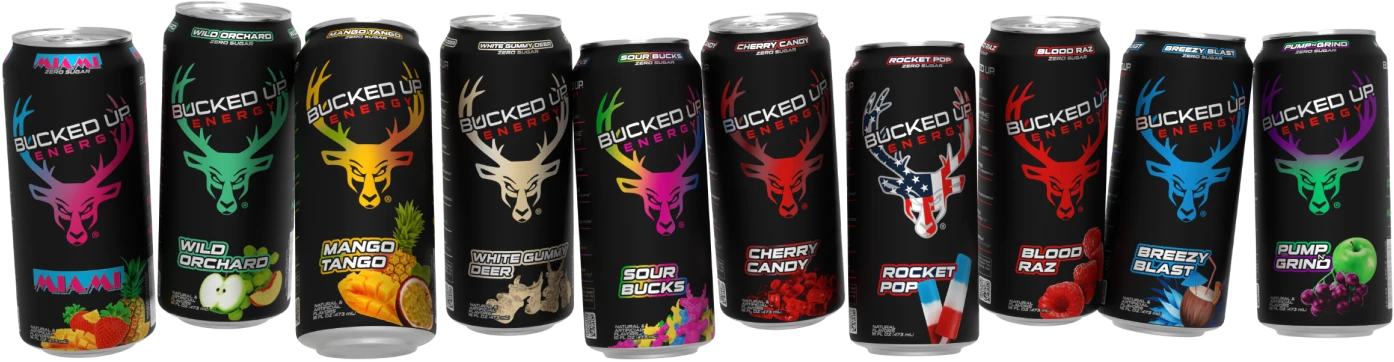
Bucked Up Energy Drinks can stand out in this framework because the label discloses exact ingredient amounts, the formulas pair caffeine with a nootropic stack rather than relying on caffeine alone, and the product comes in a ready-to-drink format for everyday use. For those who want to step up to a pre-workout format, the standard Bucked Up pre-workout delivers 200 mg caffeine anhydrous alongside AlphaSize® Alpha GPC and Taurine for a focused, clean session.* Woke AF moves to 333 mg for users with a developed tolerance to stimulants, and Mother Bucker’s 400 mg split between anhydrous and delayed-release caffeine is built for advanced athletes who need energy that lasts the full session.*
All three formulas carry full ingredient disclosure. No proprietary blends and no guessing whether the dose on the label matches what research supports.
Find Bucked Up near you and choose the formula that fits your tolerance and goals.
Frequently Asked Questions
What caffeine dose supports sustained energy without a crash?
Most research on caffeine and cognitive performance points to the range discussed earlier, where alertness and focus benefits are meaningful without overstimulation. The exact amount that works for any individual depends on body weight, habitual caffeine intake, and sensitivity. Pairing caffeine with L-theanine at roughly a 1:2 ratio is a common strategy for supporting alertness while reducing jitteriness. Delayed-release caffeine formats extend the useful window for longer sessions by delivering a second absorption phase after the initial anhydrous peak.
Why do some sugar-free energy drinks still cause a crash?
Removing sugar eliminates the glucose-insulin mechanism behind one type of crash, but it does not change caffeine’s natural half-life or the impact of missing nootropics. A sugar-free drink built on a single large dose of caffeine anhydrous with no supporting nootropic stack can still produce a noticeable drop when the caffeine clears. Many effective sugar-free formulas address both variables, combining no sugar with a nootropic stack that supports smooth, sustained focus throughout the caffeine window.
What is Alpha-GPC and why does it appear in energy and pre-workout formulas?
Alpha-GPC is a choline-containing compound that supports mental focus and the mind-to-muscle connection.* It appears in performance formulas because choline is a precursor to acetylcholine, a neurotransmitter involved in attention and muscle activation. Bucked Up uses AlphaSize® Alpha GPC, a patented form, across its pre-workout line at doses intended to support mental focus during training.* It pairs well with caffeine because it supports the cognitive dimension of performance rather than only the stimulant effect.
Is paraxanthine better than caffeine for avoiding jitters?
Paraxanthine is the primary metabolite that caffeine converts to in the body and is currently being studied in multiple registered trials for cognitive function, mental energy, and focus. Interest in paraxanthine as a standalone ingredient centers on whether it delivers caffeine-like alertness with a smoother stimulation profile. The research base is still developing compared to the extensive literature on caffeine anhydrous, so it remains a promising option to watch rather than a fully established replacement with clear dosing guidance.
Putting the Four-Criteria Framework Into Practice
Apply the four-criteria framework from the opening. Ask whether the formula passes on transparency, appropriate caffeine dosing, nootropic support, and sugar-free formulation with electrolytes.
A formula that passes all four criteria is built for sustained, focused energy that can carry you through a full training session or a long workday. A product that fails on label transparency alone makes the other three questions impossible to answer, which is a strong reason to move on.
Bucked Up Energy Drinks are formulated with transparent labeling, nootropic pairings, and sugar-free profiles designed to support steady energy and focus without the crash.*1 The full ingredient panel appears on the label, not hidden behind a blend.
Find Bucked Up near you and put this framework to work on a formula built to meet it.
*These statements have not been evaluated by the Food and Drug Administration. This product is not intended to diagnose, treat, cure, or prevent any disease.
References
Giesbrecht, T., Rycroft, J. A., Rowson, M. J., & De Bruin, E. A. (2010). The combination of L-theanine and caffeine improves cognitive performance and increases subjective alertness. Nutritional Neuroscience. https://neurosity.co/guides/best-focus-supplements-clinical-research
Owen, G. N., Parnell, H., De Bruin, E. A., & Rycroft, J. A. (2008). The combined effects of L-theanine and caffeine on cognitive performance and mood. Nutritional Neuroscience. https://neurosity.co/guides/best-focus-supplements-clinical-research
ClinicalTrials.gov. (2026). Paraxanthine studies registry. U.S. National Library of Medicine. https://clinicaltrials.gov/search
Bucked Up. (2026). Best energy alternatives 2026. https://blog.buckedup.com/2026/06/04/best-energy-alternatives-2026
1 The content provided in this article is for informational purposes only and is not medical advice. Consult with a medical professional before implementing any changes to your diet, health, or exercise routines. Individual results will vary and are based on a combination of each individual’s diet, exercise, age, and health circumstances. These statements have not been evaluated by the Food and Drug Administration. This product is not intended to diagnose, treat, cure or prevent any disease.
This article was written by Ryan Gardner, CEO of Bucked Up. As the maker of Bucked Up Energy Drinks, we have a financial interest in this information. The views expressed are our own and should be read with that context in mind.


Leave a Reply